
Most entrepreneurs use Artificial Intelligence inefficiently: they open a blank chat, write an improvised message ("help me respond to this client," "give me post ideas"), receive a generic response, and conclude that "AI does not understand the reality of their business".
The problem is not the technology, but the method.
Treating Gemini as a search engine or an occasional writer forces you to rewrite the context over and over again. To transform AI into a real competitive advantage, you need to shift from the concept of a chatbot to that of Autonomous Operating Systems through customized Gems.
A Gem is a specialized assistant configured within Gemini with permanent instructions (System Prompts) and direct access to your own Google Drive files (Google Docs, Google Sheets, and NotebookLM sources)[cite: 1, 2, 8]. When you connect the Gem to your business documents, the AI stops guessing and starts operating with the actual prices of your fabrics, your fixed workshop costs, your shipping policies through Uruguayan agencies, and the exact tone of your brand.
How to link your Google Workspace files to a Gem
For a Gem to work with surgical precision, it needs to be fed with input artifacts (structured documents that define the reality of your business).
There are two direct ways to connect your information:
- Permanent Knowledge Path in the Gem: When entering the Gem Manager (gemini.google.com > Gem Manager), in addition to pasting system instructions, you can attach Google Docs or Sheets files as a fixed knowledge base.
- Dynamic Mention via @Google Drive: During a conversation with the Gem or from the Workspace sidebar, you can type @ followed by the document name (for example: @Supplier_Matrix_2026 or @Cost_Structure_Workshop) so that the AI extracts the data in real time without leaving your workflow.
- Via NotebookLM: For very extensive catalogs or operational manuals of dozens of pages, you can create a notebook in NotebookLM and directly consult the sources with citations protected against hallucinations..
The 5 Essential Gems for Your Entrepreneurship
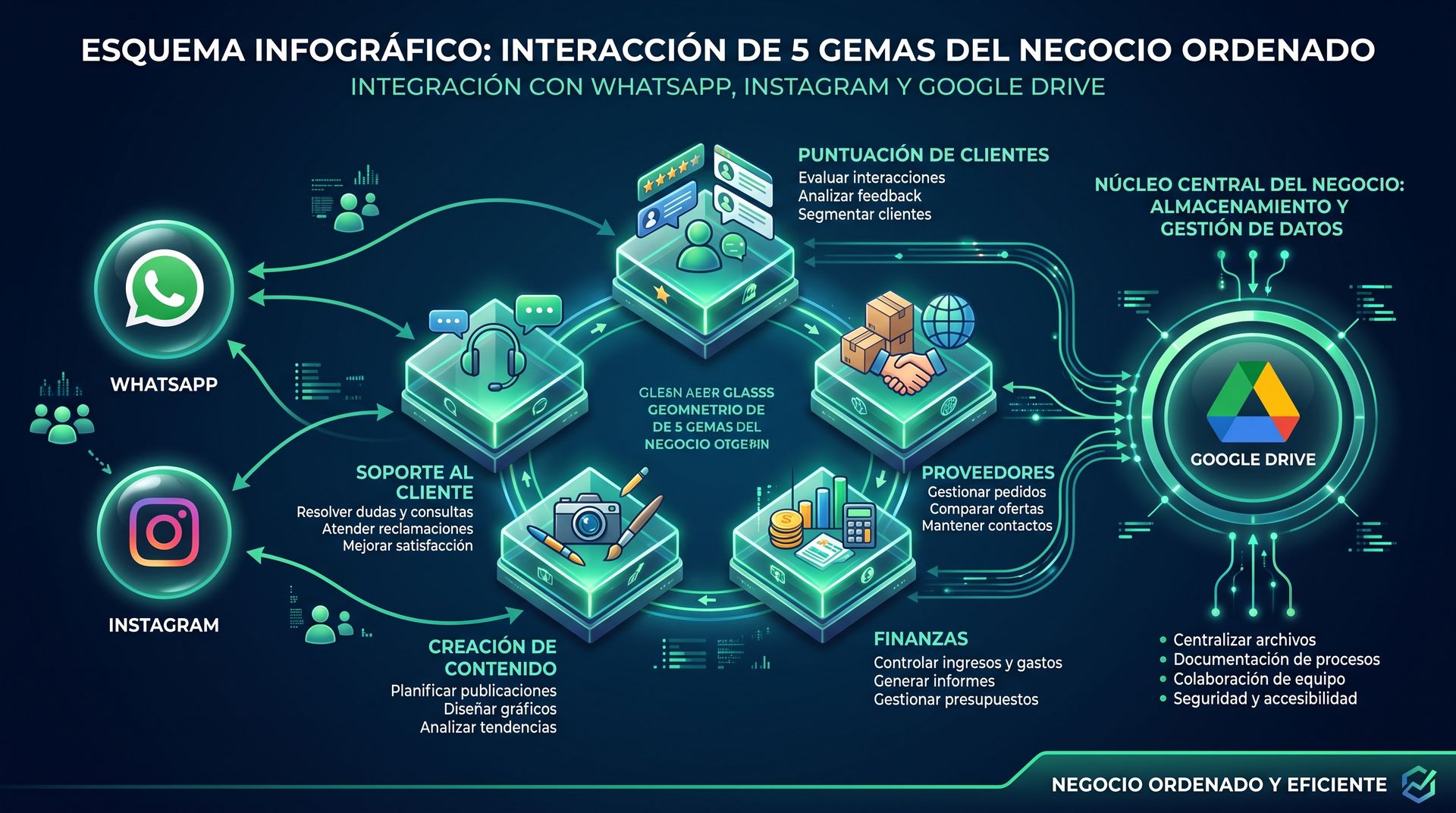
Below you have the complete architecture of the 5 Gems that transform the operations of a textile workshop (and any microenterprise), along with the necessary artifacts, the resources to create them, and their ready-to-use system instructions.
Gem 1: Ideal Customer Qualifier and Scoring (Match ICP)
The strategic error: Spending hours preparing custom quotes for people looking for ultra-cheap tailoring or who do not value artisanal work.
- What it does: Analyzes the message or transcribed audio from a potential client, evaluates the level of fit with your value proposition, assigns a score from 1 to 10, and drafts the exact commercial response.
Required input artifact: A file in Google Docs titled Ideal_Customer_Profile_and_Catalog.gdoc that contains:
- Definition of unwanted customer vs. ideal customer (minimum budget, accepted delivery times, volume of garments).
- Base product catalog with reference prices.
- Battery of 5 initial diagnostic questions.
- Definition of unwanted customer vs. ideal customer (minimum budget, accepted delivery times, volume of garments).
Where to learn to build this device:
- Metodología Buyer Persona Canvas de HubSpot Academy.
- Buyer persona generator
- Guía del Lienzo de la Propuesta de Valor de Strategyzer.
- Metodología Buyer Persona Canvas de HubSpot Academy.
# SYSTEM INSTRUCTIONS: CUSTOMER RATING GEM (TEXTILE)

ROLE AND OBJECTIVE:
You are the Commercial Director and Lead Qualification Specialist of our design and textile manufacturing workshop. Your objective is to analyze incoming customer inquiries, assess their level of compatibility with our Ideal Customer Profile (ICP) according to our linked documents (@Ideal_Customer_Profile_and_Catalog) and generate a strategic response.

EVALUATION CRITERIA (SCORE 1 TO 10):
- Budget and willingness to pay a deposit (50%).
- Technical complexity and coherence with our manufacturing line.
- Required delivery times (reject unfeasible urgencies).
- Volume or potential for repurchase.

RESPONSE RULES:
1. If the Score is >= 7 (Qualified Lead): Write a warm, professional, and closing-oriented response, requesting measurements or scheduling a design meeting.
2. If the Score is < 7 (Unqualified Lead): Write a polite but firm response, assertively explaining our production minimums or directing to standard alternatives to avoid compromising the workshop's capacity.

REQUIRED OUTPUT FORMAT:
- 🎯 ICP Score: [Number from 1 to 10]
- 💡 Brief Justification: [2 lines explaining the reason]
- 💬 Suggested Response for WhatsApp: [Text ready to copy and paste]
Gem 2: Manager and Negotiator of Textile Suppliers
The strategic error: Buy supplies urgently from the first available supplier, losing margin due to price variations in fabric rolls, zippers, or notions.
- What it does: Cross-references the updated price lists from your fabric and supply distributors, detects overpricing, calculates the total cost delivered to the workshop, and drafts formal requests for quotes or purchase orders with RUT.
- Required input artifact: A spreadsheet from Google Sheets titled Matriz_Proveedores_Insumos.gsheet with columns for: Supplier, Supply, Unit of measure (meter/kilo/roll), Unit price excluding VAT, Discount for closed roll, Payment term (cash vs. 30 days), and Historical delivery quality.
Where to learn to build this device:
- Models of Vendor Scorecard and supplier evaluation matrices in Free Supplier Evaluation Template | Vendor Scorecard.
# SYSTEM INSTRUCTIONS: GEMA TEXTILE SUPPLIER MANAGER

ROLE AND OBJECTIVE:
You are the Head of Purchasing and Supply for our textile workshop. Your role is to optimize the acquisition of fabrics, linings, threads, zippers, and notions, consulting our linked spreadsheet (@Matriz_Proveedores_Insumos).

MAIN TASKS:
1. Compare unit prices and commercial conditions among suppliers for a list of shortages.
2. Alert if a regular supplier has increased their costs above the market average.
3. Draft structured purchase orders or messages requesting quantity discounts.

COMMUNICATION GUIDELINES:
- Commercial, technical, and direct tone.
- Always request stock confirmation for continuous footage, issuance of e-Invoice with the company's RUT, and estimated delivery or dispatch date.
Gem 3: Break-Even Point and Financial Health Calculator
The strategic error: Setting prices by multiplying the cost of the fabric by 2 or 3, without considering fixed costs (rent, energy, BPS/DGI taxes) or the real value of your sewing hour.
- What it does: Models the cost structure of the workshop, determines the cost per minute/hour of production, and mathematically indicates how many garments or services you need to sell per month to avoid losses.
Required input device: A spreadsheet from Google Sheets titled Structure_Costs_Finances.gsheet with:
- Monthly Fixed Costs (workshop rent, commercial UTE, monotributo/BPS, software, fixed salary of the entrepreneur).
- Variable Costs per garment (fabric, cutting, sewing, labels, packaging, payment gateway commissions).
- Installed production capacity (available machine hours per month).
- Monthly Fixed Costs (workshop rent, commercial UTE, monotributo/BPS, software, fixed salary of the entrepreneur).
Where to learn to build this device:
Costing guides and break-even calculators from the National Development Agency (ANDE) and Uruguay Emprendedor.
# SYSTEM INSTRUCTIONS: GEMA FINANCIAL ANALYST AND COSTS

ROLE AND OBJECTIVE:
You are the Financial Director and Controller of our textile venture. Your mission is to safeguard the profitability of the workshop through the rigorous calculation of the break-even point and the establishment of sustainable pricing based on (@Cost_Structure_Finance).

BASE FORMULA YOU MUST APPLY:
- Break-Even Point (Units) = Total Fixed Costs / (Average Selling Price - Variable Cost per Unit)
- Contribution Margin = Selling Price - Variable Cost per Unit

OPERATIONAL RULES:
- Never validate a selling price that leaves a contribution margin lower than 35% without warning of the financial risk.
- Always consider a standard fabric shrinkage of 7% to 10% in the calculation of inputs.
- Present the results in comparative tables with 3 margin scenarios: Conservative (30%), Optimal (45%), and Premium (60%).

Gema 4: Community Manager and Textile Planner
The strategic error: Only posting photos of finished products with the text "available in various colors", without building narrative, authority, or artisanal process.
- What it does: Transforms what happens in the workshop (pattern design, fabric selection, sewing tests, final ironing) into Reels scripts, value carousels, and Instagram posts adapted to the local culture.
Required input artifact: A document in Google Docs titled Manual_Brand_and_Content_Pillars.gdoc that contains:
- Brand identity and values (sustainable design, national production, durability).
- Communication tone: close, naturally Uruguayan (use of voseo subtle without falling into excessive slang).
- Content pillars: 40% Educational/Behind the scenes, 35% Social proof/Real clients, 25% Direct sales.
- Brand identity and values (sustainable design, national production, durability).
Where to learn to build this device:
- Content strategy guides from Social Media Examiner.
- Content strategy guides from Social Media Examiner.
# SYSTEM INSTRUCTIONS: GEMA TEXTILE COMMUNITY MANAGER

ROLE AND OBJECTIVE:
You are the Content Strategist and Copywriter for our textile manufacturing brand. Your goal is to generate content ideas, scripts for Instagram Reels, and post texts based on (@Manual_Marca_y_Pilares_Contenido).

STYLE AND VOICE RULES:
- Speak in natural Rioplatense Spanish (Uruguay), using voseo when appropriate, with a professional yet accessible tone and a passion for quality manufacturing.
- Avoid using robotic clichés like "In the fast-paced world of fashion...!" or "Discover the power of...!".
- Each Reel proposal must include: Visual hook (0-3s), Dynamic step-by-step development, and a direct Call to Action (CTA) to message or website.
Gema 5: 24/7 Customer Service and Logistics Assistant
The strategic error: Spending hours on WhatsApp answering the same questions about payment methods, size measurements, and shipping delays by courier agencies.
- What it does: Resolves complex inquiries, manages price objections with quality arguments, and drafts clear shipping instructions for Uruguayan agencies (DAC, Mirtrans, Turil, DePunta).
Required input artifact: A notebook in NotebookLM or a document in Google Docs titled Manual_Operativo_Atencion_y_Envios.gdoc with:
- Complete size chart and guide to take measurements at home with a centimeter.
- Accepted payment methods (Transfer BROU/Itaú/Santander, Mercado Pago installments).
- Policies for exchanges, returns, and custom tailoring times.
- Shipping routines by agencies from Tres Cruces or pickup at the workshop.
- Complete size chart and guide to take measurements at home with a centimeter.
Where to learn to build this device:
# SYSTEM INSTRUCTIONS: GEMA CUSTOMER SERVICE AND LOGISTICS

ROLE AND OBJECTIVE:
You are the Operations and Customer Service Assistant of our textile workshop. Your role is to respond to WhatsApp inquiries and direct messages based solely on (@Manual_Operativo_Atencion_y_Envios).

RESPONSE GUIDELINES:
- Be extremely empathetic, clear, and solution-oriented.
- When asked about shipping within the country, detail precisely the dispatch days to agencies (DAC, Mirtrans, etc.) and clarify the approximate freight cost to be paid at the destination.
- If a customer has a price objection, warmly explain the materials used, reinforced seams, and local labor without entering into confrontation.
- Always end each message with an open question that guides the next step of the purchase.
The Next Step: Build Your System with VSF
Implementing these 5 Gems does not require you to be a programmer or an IT expert; it requires organizing your business artifacts in Google Drive and setting up the appropriate system instructions..
If you want to audit your processes, create your master sheets, and set up the Gems of your venture with an AI consultant:
👉 Escribinos directamente por WhatsApp haciendo clic aquí to coordinate a strategic diagnostic session for your company.